How to Use AI for Interview Preparation: A Complete Guide

Table of Contents
- 2.3 Realistic Mock Interview Practice
- 2.4 Better Resume and Project Preparation
- 2.5 Cost-Effective and Flexible Practice
- 2.6 A More Focused Preparation Strategy
- 3. How to Use AI for Interview Preparation: Step-by-Step Guide
- Step 1: Identify Your Target Job Role
- Step 2: Analyze the Job Description
- Step 3: Upload or Share Your Resume
- Step 4: Generate Role-Specific Interview Questions
- Step 5: Practice Answering Questions Before Looking at Solutions
- Step 6: Conduct a Realistic AI Mock Interview
- Step 7: Review Your Weaknesses and Repeat
- Step 8: Create a Final Interview Revision Sheet
AI can help you prepare for job interviews by generating personalized interview questions, conducting realistic mock interviews, improving your answers, analyzing your resume, identifying skill gaps, and providing feedback on your communication. To use AI effectively for interview preparation, start by sharing your resume and target job description with an AI tool, generate role-specific questions, practice answering them aloud, and use an AI interview simulator to improve your performance. Whether you are preparing for a technical interview, HR round, behavioral interview, coding assessment, or campus placement, AI-powered interview preparation can help you practice consistently, identify weaknesses, and become more confident before the actual interview.
Preparing for a job interview can be stressful, especially when you do not know which questions an interviewer might ask or how to present your experience effectively. Reading interview questions online and memorizing answers may help you understand common topics, but it does not necessarily prepare you for follow-up questions, unexpected situations, or the pressure of answering in real time.
This is where artificial intelligence (AI) can make a significant difference.
Modern AI tools can act as interview coaches, generate questions based on your experience, simulate conversations with recruiters, evaluate your answers, and help you develop stronger communication skills. Instead of following a generic preparation routine, you can create a personalized interview preparation plan based on the job you want and the skills you need to demonstrate.
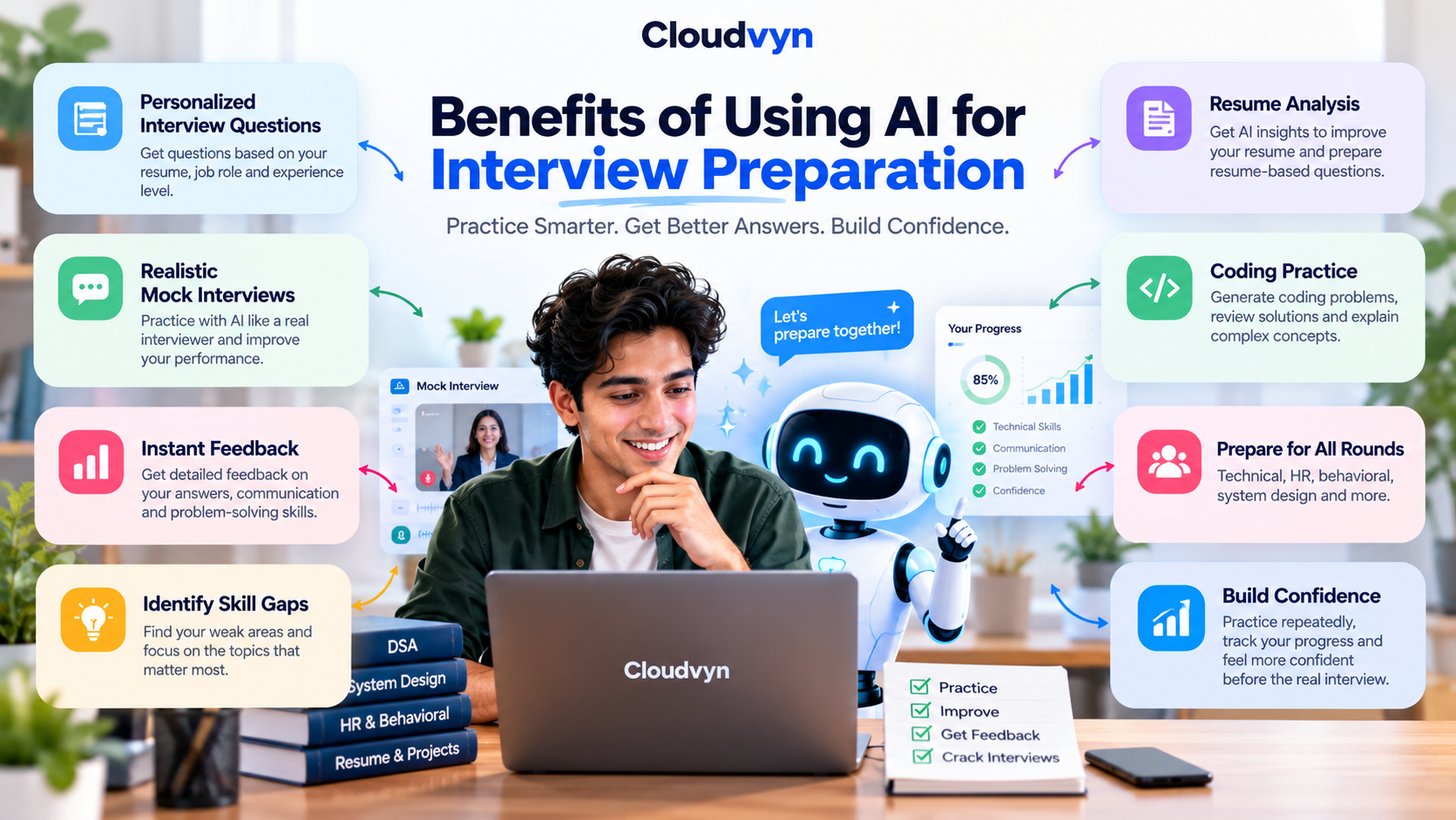
In this guide, you will learn how to use AI for interview preparation, which tools and techniques to consider, how to practice different types of interviews, and how to build a practical preparation strategy that improves your chances of performing well.
For instance, you might explain how JWT authentication works but forget to discuss token expiration, refresh tokens, or secure token storage.
An AI interviewer can highlight these omissions and help you develop a more complete explanation.
Important: AI feedback is not always correct. Verify technical explanations against reliable documentation and test suggested code when necessary.
2.3 Realistic Mock Interview Practice
Reading questions does not reproduce the experience of answering them under pressure.
A mock interview helps you practice recalling information, organizing your thoughts, and responding naturally.
AI interview simulators can ask questions one at a time, evaluate your responses, and introduce follow-up questions based on what you say.
For example:
Interviewer: How would you improve the performance of a slow Node.js API?
Candidate: I would check the database queries and optimize the code.
Interviewer: What would you investigate if the database queries were already optimized but the API was still slow?
This follow-up encourages you to consider other possibilities, including network latency, external API calls, event-loop blocking, inefficient serialization, and resource constraints.
Practicing these conversations can help you become more comfortable with the unpredictability of real interviews.
2.4 Better Resume and Project Preparation
Recruiters and technical interviewers frequently ask candidates to explain the projects listed on their resumes.
They may ask why you selected a particular technology, how you designed the architecture, what challenges you encountered, and how you measured the results.
AI can analyze your resume and generate questions about individual projects.
If you built an e-commerce application using React, Node.js, Express, and MongoDB, AI might ask:
How did you design the database schema?
How did you implement authentication?
How did you protect private routes?
How would you handle a sudden increase in traffic?
How would you prevent duplicate orders?
How would you improve database query performance?
What would you change if you rebuilt the application?
These questions help you prepare to explain not only what you built but also why you built it that way.
2.5 Cost-Effective and Flexible Practice
Finding a professional interview coach or arranging frequent mock interviews with experienced developers may not always be practical.
AI tools can provide an additional source of practice at any time, although some platforms charge for advanced features.
You can practice early in the morning, after work, or shortly before an interview. You can also repeat the same exercise until you improve.
AI does not replace experienced mentors, but it can make regular interview practice easier to maintain.
2.6 A More Focused Preparation Strategy
Without a structured plan, candidates often spend too much time reading familiar topics and too little time practicing weak areas.
AI can help organize preparation into specific tasks.
For example:
Monday: JavaScript fundamentals and asynchronous programming.
Tuesday: Node.js and Express.js.
Wednesday: Database design and query optimization.
Thursday: Coding problems and data structures.
Friday: System design and project discussions.
Saturday: Technical mock interview.
Sunday: Review mistakes and repeat difficult questions.
You can adjust this schedule based on your interview date and the job description.
3. How to Use AI for Interview Preparation: Step-by-Step Guide
The most effective approach is to use AI throughout the preparation process rather than relying on it only to generate questions.
Step 1: Identify Your Target Job Role
Begin by identifying the position you want to apply for.
Examples include:
Software Engineer
Frontend Developer
Backend Developer
Full-Stack Developer
Data Analyst
Machine Learning Engineer
Product Manager
Business Analyst
Sales Executive
Customer Support Specialist
The target role determines which skills, questions, and interview formats you should prioritize.
For example, a backend developer may need to prepare for API design, databases, authentication, debugging, and system design. A data analyst may need to focus on SQL, spreadsheets, statistics, dashboards, and business problem-solving.
AI prompt:
"Act as an experienced technical recruiter. I am preparing for a [job title] position with [experience level]. Identify the most important technical skills, practical abilities, and interview topics I should prepare for. Organize them by priority and explain why each topic matters."
Use the response to create an initial preparation checklist.
Step 2: Analyze the Job Description
The job description provides clues about what an employer expects from a candidate.
Copy the job description into an AI tool and ask it to identify the most important requirements.
Ask the AI to separate the requirements into categories such as:
Mandatory technical skills.
Preferred technical skills.
Practical responsibilities.
Communication and teamwork requirements.
Domain-specific knowledge.
Potential interview topics.
For example, consider a backend developer job description mentioning Node.js, Express.js, MongoDB, Redis, REST APIs, Docker, and cloud deployment.
AI can help you organize these skills into preparation categories and identify which ones require the most attention.
AI prompt:
"Analyze the following job description for a [job title] position. Extract the required technical skills, preferred skills, responsibilities, and soft skills. Predict relevant interview topics based on the requirements, separating high-priority topics from lower-priority ones. Explain that these are preparation priorities, not guaranteed interview questions.
Job description:
[Paste the job description here]"
This process helps you avoid spending hours studying technologies that are unrelated to the role.
Step 3: Upload or Share Your Resume
Your resume is another important source of potential interview questions.
Recruiters may ask about anything you have listed, including technologies, projects, responsibilities, certifications, and professional achievements.
Share your resume with an AI tool that supports document input. If document upload is unavailable, paste the relevant sections.
Ask the AI to examine your resume from the perspective of a hiring manager.
Look for:
Skills that require stronger explanations.
Projects that may attract follow-up questions.
Claims that need supporting evidence.
Technologies that you have listed but cannot confidently explain.
Experience that needs clearer examples.
Potential inconsistencies between your resume and the job description.
AI prompt:
"Act as a hiring manager interviewing me for a [job title] position. Analyze my resume and generate 25 realistic interview questions based on my projects, skills, experience, and achievements. Include basic, intermediate, and advanced questions. Focus particularly on questions that test whether I genuinely understand the technologies and work described in my resume."
Do not exaggerate your experience or invent achievements when improving your resume or preparing answers. Your interview responses should accurately reflect what you have done.
Step 4: Generate Role-Specific Interview Questions
Once you understand the job requirements and your resume, generate a question bank.
Ask the AI to divide the questions into relevant categories.
For a software development role, these could include:
Category | Example Question |
|---|---|
Fundamentals | What is the difference between synchronous and asynchronous programming? |
Programming language | How does JavaScript handle closures? |
Frameworks | How does middleware work in Express.js? |
Databases | When would you use an index in MongoDB? |
APIs | How would you design a secure REST API? |
Security | How would you protect an application against common web vulnerabilities? |
System design | How would you design a notification service? |
Projects | Explain the architecture of your most complex project. |
Behavioral | Tell me about a difficult technical problem you solved. |
The exact questions will depend on the position and employer.
AI prompt:
"Generate 40 interview questions for a [job title] position based on this job description and resume. Divide the questions into technical fundamentals, practical scenarios, project discussions, system design, problem-solving, and behavioral questions. Assign a difficulty level to each question. Do not provide the answers yet because I want to practice answering them myself."
Generating questions without answers initially is important because it encourages active recall instead of passive reading.
Step 5: Practice Answering Questions Before Looking at Solutions
This is one of the most important steps.
When AI provides a question, try answering it independently before asking for an explanation.
You can type your response or answer aloud if the tool supports voice interaction.
After answering, ask AI to evaluate your response using a consistent framework:
Technical accuracy.
Completeness.
Clarity.
Practical examples.
Relevance to the question.
Overall answer structure.
Ask the AI to identify what you missed and provide a stronger example answer.
For behavioral questions, it can also evaluate whether your response includes the situation, your responsibility, your actions, and the outcome.
Avoid memorizing the improved answer word for word. Focus on understanding the important concepts and explaining them naturally.
Step 6: Conduct a Realistic AI Mock Interview
Once you have practiced individual questions, move to a simulated interview.
Ask the AI to act as an interviewer and follow realistic interview rules.
For example, instruct it to:
Ask one question at a time.
Wait for your answer.
Avoid revealing the ideal answer in advance.
Ask follow-up questions based on your response.
Increase the difficulty gradually.
Evaluate your performance at the end.
Identify your three biggest weaknesses.
A mock interview should resemble an actual conversation rather than a quiz in which the candidate immediately receives the correct answer.
For the best results, set a time limit and avoid checking notes while answering.
If you are preparing for a technical interview, include practical scenarios and questions about your previous projects.
Step 7: Review Your Weaknesses and Repeat
After completing a mock interview, review the feedback carefully.
Do not focus only on the overall score. Identify the specific areas where your answers were weak.
For example:
Weakness | Improvement Strategy |
|---|---|
Incomplete technical explanations | Review the underlying concepts and explain them in your own words. |
Poor answer structure | Use a clear beginning, explanation, and conclusion. |
Lack of practical examples | Connect concepts to projects or real-world scenarios. |
Difficulty with follow-up questions | Practice explaining why a solution works and what its limitations are. |
Slow coding performance | Practice timed problems and review common patterns. |
Nervous or hesitant delivery | Practice speaking aloud and recording your responses. |
Weak project explanations | Review architecture, trade-offs, challenges, and your individual contributions. |
Repeat the questions you struggled with after reviewing the relevant material.
You can also ask the AI to create new questions testing the same concepts. This helps you determine whether you understand the subject rather than merely remembering one answer.
Step 8: Create a Final Interview Revision Sheet
Before the interview, prepare a compact revision document.
Include:
The most important concepts from the job description.
Questions you answered incorrectly.
Key points for explaining your projects.
Important technical trade-offs.
Behavioral examples from your experience.
Questions you want to ask the interviewer.
AI can help organize your notes into a concise revision sheet.
Use it to review important topics instead of attempting to learn an entirely new subject at the last minute.
The goal is to enter the interview with a clear understanding of your strengths, your projects, and the skills required for the position.
Start Today
AI interview by cloudvyn
Frequently Asked Questions
How can I use AI for interview preparation?
You can use AI to analyze job descriptions, generate personalized interview questions, evaluate your answers, practice mock interviews, prepare resume-based questions, and improve communication skills. Start by sharing your target job description with an AI tool, practicing relevant questions, reviewing feedback, and repeating the questions you find difficult.
Which AI tool is best for interview preparation?
The best AI tool depends on your preparation needs. General-purpose AI assistants can generate interview questions and explain concepts, while dedicated AI interview simulators can provide structured mock interview practice. Coding platforms combined with AI assistance are useful for technical interviews.
Can AI conduct a mock interview?
Yes. AI interview tools can simulate interviews by asking questions, evaluating responses, and generating follow-up questions. Some platforms also support voice or video-based practice. For realistic preparation, practice answering one question at a time without viewing the ideal answer beforehand.
Can AI help me prepare for technical interviews?
Yes. AI can help you prepare for technical interviews by explaining programming concepts, generating coding challenges, reviewing your solutions, and asking questions about databases, APIs, operating systems, computer networks, and system design. It can also simulate technical interview rounds for specific job roles.
How can I use AI to prepare for a coding interview?
Start by asking AI to generate coding problems based on your experience level and target company. Solve each problem independently before requesting hints or explanations. You can then ask AI to evaluate your solution's correctness, time complexity, space complexity, and edge cases.
Can AI help me answer HR interview questions?
Yes. AI can help you prepare answers to common HR questions, including "Tell me about yourself," "What are your strengths and weaknesses?" and "Why should we hire you?" Share your actual experience and achievements so the answers remain authentic and relevant to the job.
How can AI improve my resume for interviews?
You can use AI to compare your resume with a job description, identify missing skills, improve bullet points, and generate interview questions based on your projects and experience. This helps you prepare to explain your achievements and discuss the technical decisions behind your work.
Can AI help freshers prepare for job interviews?
Yes. Freshers can use AI to practice fundamental technical questions, prepare HR answers, explain academic projects, improve communication skills, and simulate entry-level interviews. AI can also help create a structured study plan based on the job description and the candidate's current knowledge.