You've polished your resume. You're genuinely qualified. But somehow you never hear back. Sound familiar?
Chances are, an AI tool screened your resume before any human even glanced at it — and it didn't make the cut. Now you've heard that some companies let you opt out of AI resume screening, and you're wondering: should I actually do that?
Short answer: it depends on the role, the company, and how your resume is built. But let's go through everything so you can make the right call for your situation.
What Is AI Resume Screening?
Before we talk about opting out, let's make sure we're on the same page about what AI resume screening actually is — because a lot of people confuse it with basic ATS software.
ATS vs. AI Screening: Not the Same Thing
An Applicant Tracking System (ATS) is software that organizes and stores job applications. Nearly every mid-to-large company uses one. ATS tools like Greenhouse, Workday, or Lever collect your resume and track your application status.
AI resume screening is a layer on top of that. It's when the system actually reads your resume and scores it — looking at your skills, work history, education, and how well you match the job description. Some tools rank candidates, others filter out anyone below a certain score automatically.
Key distinction: Even if a job doesn't use AI screening tools specifically, the ATS still parses your resume into plain text. Bad formatting can still hurt you in either case.
How Does the Screening Actually Work?
Here's a simplified look at what happens when you hit submit:
- Your resume is parsed into text — tables, images, and fancy formatting may get stripped out.
- The system scans for keywords from the job description — skills, job titles, certifications.
- A relevance score or ranking is assigned to your application.
- Top-scoring resumes move to a recruiter's review queue; lower ones may never be seen.
Some AI tools go further — they analyze tone, career progression, gaps in employment, and even predict "culture fit." That's a whole separate conversation.
Why Companies Use AI Resume Screening
It's not personal. When a job posting gets 500 applications in 48 hours, a recruiter simply cannot read every single one. AI screening exists because the volume of applicants has exploded, and companies need a way to move fast.
- Speed: AI can pre-screen hundreds of resumes in seconds.
- Consistency: It applies the same criteria to every resume, reducing some forms of bias (though it introduces others).
- Cost: Fewer recruiter hours needed at the top of the funnel.
- Scale: A company hiring for 50 roles at once simply can't manually review thousands of applications.
The system isn't perfect — and many recruiters know it. But it's not going away either. That's why understanding it is worth your time.
Can You Actually Opt Out of AI Resume Screening?
Honestly? In most cases, no. But the landscape is slowly changing.
As of 2026, a handful of jurisdictions — including New York City — have passed laws requiring employers to disclose when AI tools influence hiring decisions, and some provide applicants a right to request human review. But this is the exception, not the rule.
| Scenario | Can You Opt Out? |
|---|---|
| Company in NYC using automated hiring tools | Sometimes — by law, if they use covered tools |
| Company using standard ATS (Workday, Greenhouse) | No opt-out available |
| Smaller company using manual process | Not applicable — you're already going to a human |
| LinkedIn Easy Apply or job boards | No opt-out, varies by company |
| Referral from inside the company | Often bypasses screening entirely |
Important: Even if you email a recruiter directly or request human review, your resume may still enter the ATS and be screened automatically before anyone reads your email.
Pros of Opting Out of AI Resume Screening
If you can opt out, there are some real benefits — depending on your situation.
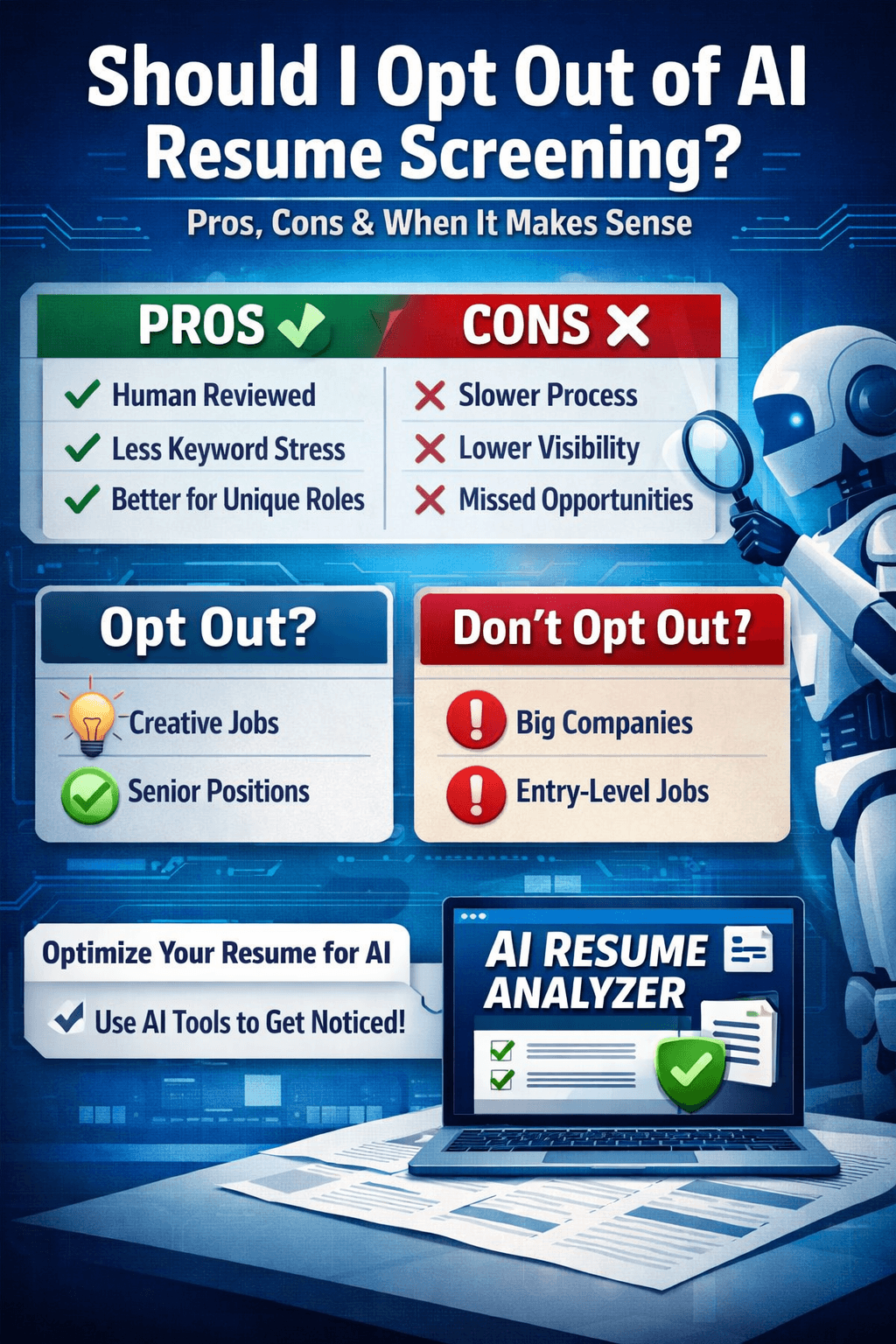
Reasons to Opt Out
- A human recruiter may genuinely read your resume
- Your personality, story, and career path can come through
- Less pressure to keyword-stuff your resume
- Unconventional backgrounds have a better shot
- Career changers aren't penalized for mismatched titles
- Portfolio work and context matter more with humans
Risks of Opting Out
- Manual review queues may be slower or deprioritized
- Recruiters at large companies are overwhelmed — your opt-out may get lost
- Application may still enter ATS regardless
- Reduced visibility or priority in some systems
- No guarantee a human will actually see it faster
Cons of Opting Out
The idea of a real human reading your resume sounds great. But here's the thing — at many companies, the recruiter's inbox is just as flooded as the ATS queue.
When you opt out, you're often placed in a separate pile without the automated prioritization that helps recruiters focus their attention. In practice, this can mean:
- Your application sits longer without any action.
- A recruiter who receives 200 opt-out requests may still use keyword-scanning manually, making the opt-out pointless.
- You may miss automated updates on your application status.
- It signals extra effort on your part — which can be good or bad depending on the reader.
Bottom line: opting out is not a magic ticket to the interview stage. It shifts the bottleneck, but doesn't remove it.
When You Should Consider Opting Out
There are specific situations where opting out genuinely makes sense and may increase your chances:
Good Candidates for Opting Out
- Creative roles — design, writing, art direction — where work samples matter more than keyword counts
- Senior or executive roles — where reputation, network, and narrative carry weight
- Referral situations — when someone inside the company is already expecting your application
- Boutique or specialized firms — small shops often have a real human reading every application
- Career changers — your experience is valuable but doesn't fit the AI's pattern matching
When to Skip Opting Out
- High-volume corporate roles — hundreds of applicants, AI screening is baked into the process
- Big tech companies — Google, Amazon, Meta rely heavily on structured ATS pipelines
- Entry-level positions — human review at this level is rare at large companies
- Government or enterprise jobs — highly structured, ATS-first hiring
When You Should NOT Opt Out
If the company processes thousands of applications, your opt-out request has almost zero chance of making a meaningful difference. In these cases, your energy is better spent making your resume work with the AI, not around it.
For entry-level roles especially, recruiters are often managing dozens of open positions at once. They rely on AI tools not because they want to, but because they have no other realistic option. Opting out at this stage often just means being deprioritized.
Better use of your time: Instead of opting out, spend 20 minutes tailoring your resume to the specific job description. That single change does more for your chances than any opt-out request.
How to Optimize Your Resume for AI Screening
Since opting out isn't always possible — and often not advisable — learning to work with AI screening tools is the more practical skill to build. Here's what actually moves the needle:
1. Match Keywords from the Job Description
Read the job posting carefully. The exact phrases they use for skills and requirements are likely the same ones the AI is scanning for. If the posting says "project management," don't just write "managed projects." Use their language.
2. Use Clean, Simple Formatting
Multi-column layouts, graphics, icons, and tables look great to human eyes — but they create parsing nightmares for AI tools. Stick to a single-column layout with standard fonts. Avoid headers and footers for key information when possible.
3. No Images, Charts, or Logos
Any content inside an image is invisible to AI screening tools. Your contact info, a logo for a former employer, or a skill bar chart — none of that gets parsed. Keep everything as plain text.
4. Tailor Every Resume
A generic resume is an AI's dream — to reject. Each application deserves its own version that mirrors the job description. Adjust your summary, reorder your bullet points, and make the most relevant experience obvious.
5. Use Standard Section Headings
Use recognizable headings: Work Experience, Education, Skills, Certifications. Creative alternatives like "My Journey" or "Who I Am" confuse parsers and those sections may be skipped entirely.
Tools That Help You Optimize Your Resume for AI
Knowing the rules is one thing. Actually checking whether your resume follows them is another. That's where tools come in.
Cloudvyn Resume Analyzer
Upload your resume and get instant feedback on ATS compatibility, keyword gaps, and formatting issues — before you hit submit.
- Detects ATS parsing problems
- Suggests missing keywords based on your target role
- Flags formatting elements that trip up AI screeners
- Real-time editing with instant re-analysis
Other tools worth knowing about include Jobscan (matches your resume to job postings) and Resume Worded (gives a score with specific feedback). But for an all-in-one workflow that keeps you in the loop on exactly what an AI screener sees, Cloudvyn's analyzer is worth checking out first.
Also worth reading: our guide on how to optimize your resume for remote job applications, and if you want to explore builder options, we've also covered the best AI resume builders in the US right now.
Final Verdict: Should You Opt Out of AI Resume Screening?
Our Take
For most people, in most job applications: No, don't opt out. The better move is to optimize your resume so it performs well in AI screening — that's a skill that pays off across every application you submit.
If you're applying for a creative or senior role, going through a referral, or applying at a smaller company that explicitly offers human review — then yes, opting out is worth exploring.
The real answer isn't binary. Build a resume that works for both humans and AI. That way, you're not stuck hoping one path works — you're covered either way.
Frequently Asked Questions
Should I opt out of AI resume screening?
It depends on the role and company. For creative or senior positions where a referral is involved, opting out can work in your favor. For high-volume corporate or tech hiring, opting out typically won't help — focus on optimizing your resume instead.
Can you actually opt out of AI resume screening?
Sometimes, but rarely. A small number of companies — particularly in cities with hiring AI laws like NYC — offer this option. Most ATS platforms don't have an opt-out mechanism at all. Whether it's available depends entirely on the company's hiring platform and local regulations.
How do I know if a company uses AI to screen resumes?
It's not always disclosed. A good indicator is the job platform they use — Workday, Greenhouse, iCIMS, and similar platforms typically feed into AI screening tools. You can also check the company's privacy policy or reach out to the recruiter directly and ask.
Does opting out mean a human actually reads my resume?
Not necessarily. Even when you opt out, your resume may still enter the ATS database. And recruiters managing high volumes of applications may still scan manually using keywords. There's no guarantee of a thoughtful human review just because you requested one.
How do I make my resume pass AI screening?
Use clean single-column formatting, match exact keywords from the job description, avoid images and tables, and tailor your resume for each role. Tools like the Cloudvyn Resume Analyzer can help you spot specific ATS issues before you apply.
Are there laws about AI resume screening?
Yes, and they're growing. New York City's Local Law 144 requires employers to audit and disclose the use of automated employment decision tools. Other states are working on similar legislation. Check local regulations in your area to understand your rights as a job applicant.