Will AI Replace Technical Interviewers? The Truth About AI Hiring in 2026
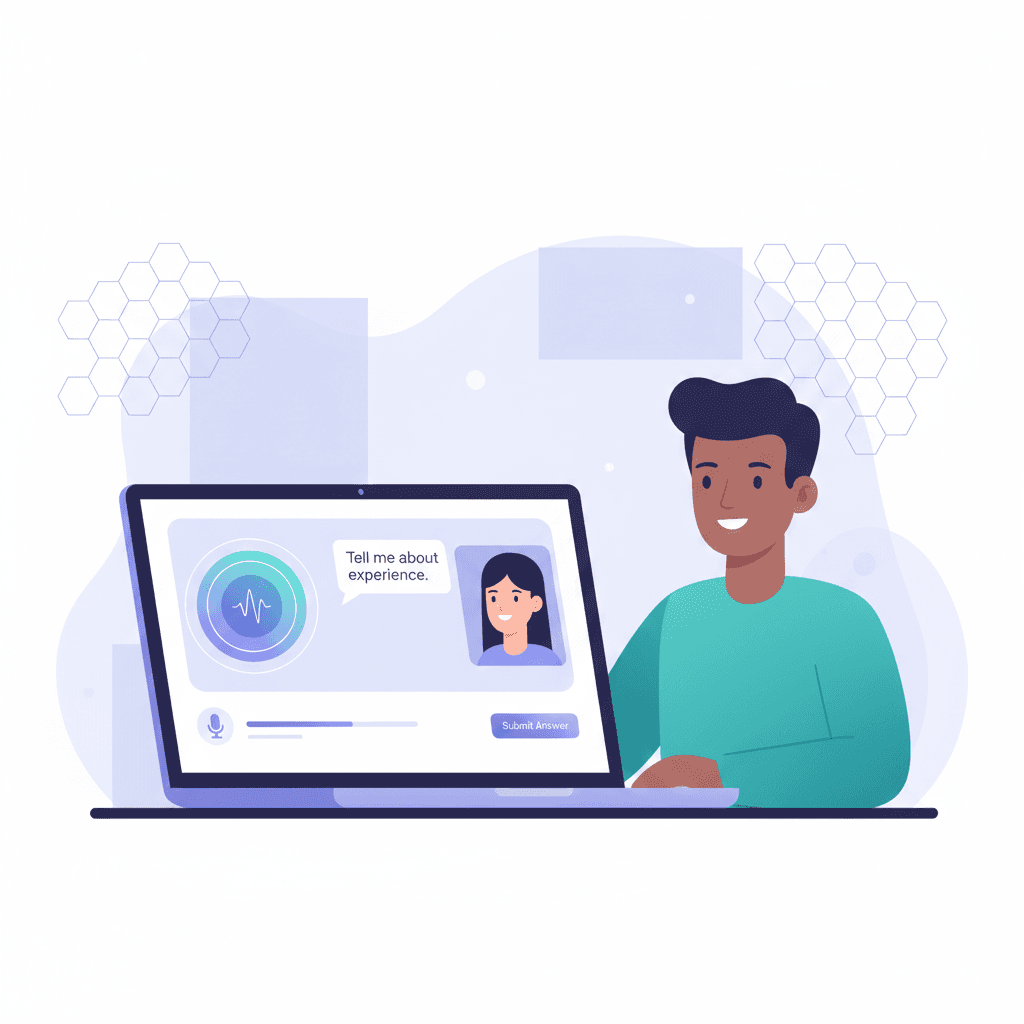
Will AI Replace Technical Interviewers? The Real Future of Tech Hiring
Imagine joining a coding interview… and your interviewer is an AI. This might seem futuristic, but it's becoming the new reality. The question everyone's asking: will AI replace technical interviewers entirely, or is this just another tool in the hiring toolkit?
1. Introduction — The Big Question Everyone Is Asking
Picture this: you're sitting at your desk, ready for a technical interview. You click the video link, and instead of a friendly engineer on the other side, you're greeted by an AI voice asking you to solve a coding problem. No small talk. No human connection. Just you and the algorithm.
This isn't some distant future scenario—it's happening right now. Around 75% of tech companies are already using AI tools somewhere in their interview or screening process. Nearly 1 in 3 companies use AI for early-stage interviews. Voice-based interview platforms, automated coding assessments, and AI-powered screening tools are becoming the norm.
But here's the real question: Will AI replace human technical interviewers?
The answer isn't as simple as yes or no. AI is transforming how companies hire, but it's not replacing humans entirely—at least not yet. In this article, we'll explore where AI is already being used, where it excels, where it falls short, and what the future actually looks like for technical interviews.
2. How Technical Interviews Traditionally Work
Before we dive into AI's role, let's recap how technical interviews have worked for decades. Understanding the traditional process helps us see where AI fits—and where it doesn't.
The Classic Technical Interview Process
Most tech hiring follows a predictable pattern:
- Resume screening: Recruiters review hundreds of resumes to identify qualified candidates.
- Online coding test: Candidates complete a timed coding challenge to demonstrate basic skills.
- Technical interview with an engineer: A human interviewer asks coding questions, evaluates problem-solving, and assesses technical depth.
- System design or architecture round: For senior roles, candidates discuss how they'd build complex systems.
- Cultural fit interview: A final round to evaluate collaboration, communication, and team alignment.
Why Human Interviewers Mattered
Human interviewers brought something AI can't easily replicate:
- Evaluate thinking process: They could see how you approach problems, not just whether you get the right answer.
- Ask follow-up questions: Good interviewers dig deeper based on your responses, exploring edge cases and trade-offs.
- Assess collaboration and communication: They gauge how well you explain your thinking and work with others.
This human element has been the cornerstone of technical hiring. But as companies scale and hiring volumes explode, many are asking: can AI do this faster and cheaper?
3. How AI Is Already Entering Technical Interviews
AI isn't just knocking on the door—it's already inside. Let's look at where AI interviewers and automated systems are being used today.
Where AI Is Used Today
Current AI Applications in Technical Hiring:
- Resume screening: AI scans thousands of resumes, identifying keywords and matching candidates to job requirements.
- Coding assessments: Automated platforms evaluate code quality, efficiency, and correctness without human review.
- Video interview scoring: AI analyzes facial expressions, tone, and word choice to assess candidate confidence and communication.
- Scheduling and automation: AI handles interview logistics, freeing up recruiter time.
- AI-led mock interviews: Platforms like Cloudvyn offer voice-based practice interviews to help candidates prepare.
📊 Key Statistics:
- 87% of companies use AI somewhere in recruitment.
- Some companies allow AI to conduct entire first-round interviews directly.
- AI interviewers help recruiters handle 40% more candidates in the same timeframe.
The trend is clear: AI is becoming a standard part of the hiring pipeline. But that doesn't mean it's taking over completely.
4. Why Companies Want AI Interviewers
Let's be honest—companies aren't adopting AI just because it's trendy. There are real, practical reasons why AI technical interviews are appealing to hiring managers.
1. Speed
Traditional interviews are slow. Coordinating schedules, conducting multiple rounds, and waiting for feedback can stretch hiring timelines to weeks or months. AI changes that:
- Faster screening of large candidate pools
- Reduced time-to-hire (some companies report 11 days faster hiring with AI)
- Instant evaluation and feedback
2. Cost Savings
Human interview hours are expensive. Every hour an engineer spends interviewing is an hour they're not coding. AI reduces this cost:
- Fewer human interview hours needed
- Automated scheduling and evaluation
- Lower overhead for high-volume hiring
3. Scalability
Here's where AI really shines: it can interview thousands of candidates simultaneously. A human interviewer can only handle a few interviews per day. AI has no such limits.
📊 Real-World Impact:
AI interviewing has reduced hiring time by 11 days on average in some organizations. For companies hiring hundreds or thousands of people, that's a massive efficiency gain.
But speed and cost aren't everything. What about quality?
5. Where AI Interviewers Work Best
AI isn't good at everything, but it excels in specific scenarios. Here's where automated technical interviews actually make sense.
Ideal Use Cases for AI Interviewers
AI Excels At:
- First-round screenings: Filtering out unqualified candidates quickly and objectively.
- Basic coding tests: Evaluating syntax, logic, and algorithm knowledge.
- High-volume hiring: When you need to process hundreds or thousands of applicants.
- Entry-level roles: Where technical requirements are more standardized.
- Standardized skill checks: Testing specific, well-defined competencies.
The common thread? AI excels at repetitive, structured evaluations. If the question has a clear right or wrong answer, AI can handle it efficiently.
Think of it this way: if you're testing whether a candidate knows how to reverse a linked list, AI can evaluate that perfectly. But if you're trying to understand why they chose a particular approach or how they'd optimize it for a real-world system, that's where things get tricky.
6. Where AI Still Struggles
Now for the reality check. AI has serious limitations when it comes to technical interviews. Let's talk about where it falls short.
Major Limitations of AI Interviewers
1. Understanding Deep Problem-Solving
AI can check if your code works, but it struggles to evaluate how you think through complex problems. System design discussions, architecture trade-offs, and creative problem-solving require human judgment.
2. Context and Creativity
What if a candidate solves a problem in an unconventional way? AI often flags non-standard solutions as incorrect, even if they're valid. Human interviewers can recognize creative thinking and ask follow-up questions to understand the reasoning.
3. Bias and Fairness Issues
Studies have shown that AI can exhibit bias based on accent, speech patterns, or even video background. Only 26% of candidates trust AI evaluations, partly because of these fairness concerns.
4. Poor Candidate Experience
Let's be blunt: many candidates find AI interviews cold and impersonal. There's no rapport, no human connection, and no opportunity to showcase personality or passion for the role.
5. Trust Issues
Research shows that only 26% of candidates trust AI to evaluate them fairly. That's a problem for employer branding and candidate experience.
These limitations are why most companies aren't going all-in on AI interviewers. Instead, they're finding a middle ground.
7. What Big Companies Are Actually Doing
So what's the real-world approach? How are major tech companies actually using AI in their hiring processes?
The Hybrid Model Is the Norm
Most large companies use a hybrid approach:
- AI for early rounds: Automated screening, coding tests, and initial assessments.
- Humans for final technical evaluation: Senior engineers conduct in-depth interviews for qualified candidates.
📊 Industry Reality:
Even large tech companies that experimented with fully automated interviews are reintroducing human interview rounds because AI struggles to evaluate technical depth and problem-solving nuance.
93% of hiring managers say human involvement is still essential in the hiring process.
The takeaway? AI is a tool, not a replacement. Companies use it to handle the heavy lifting—screening thousands of resumes, running basic tests—but they still rely on humans for the final decision.
8. The Real Future: AI + Human Interviewers
Here's what the future of technical interviews actually looks like: collaboration between AI and humans, not replacement.
How Roles Will Change
| AI Will Handle | Humans Will Handle |
|---|---|
| Screen candidates at scale | Evaluate problem-solving depth |
| Generate interview questions | Assess communication and collaboration |
| Analyze basic responses | Evaluate cultural fit |
| Assist interviewers with data | Make final hiring decisions |
| Automate scheduling and logistics | Conduct system design discussions |
AI serves as a support tool, not the final authority. It handles the repetitive, time-consuming tasks, freeing up human interviewers to focus on what they do best: evaluating complex thinking, creativity, and fit.
9. How Technical Interviews Are Already Changing
AI isn't just changing who conducts interviews—it's changing the interview format itself.
New Trends in Technical Interviews
Evolving Interview Formats:
- Open-book coding interviews: Less focus on memorization, more on problem-solving with resources available.
- AI-assisted coding tasks: Candidates use AI tools (like GitHub Copilot) during interviews, reflecting real-world work.
- Real-world problem solving: Companies are moving away from abstract algorithms toward practical challenges.
- Pair-programming style interviews: Collaborative coding sessions that mimic actual teamwork.
- System design over algorithms: Greater emphasis on architecture and scalability discussions.
Why the shift? Partly because AI cheating concerns are forcing companies to rethink how they evaluate candidates. If AI can solve coding problems instantly, companies need to test skills AI can't replicate—like system design, trade-off analysis, and communication.
10. What This Means for Developers and Job Seekers
So what should you, as a developer or job seeker, do about all this? How do you prepare for an AI-driven interview landscape?
Skills That Will Matter More
Focus on These Skills:
- Problem-solving: Not just coding, but explaining your thought process clearly.
- System design: Understanding architecture, scalability, and trade-offs.
- Communication: Articulating your ideas clearly, whether to AI or humans.
- Real-world project experience: Demonstrating practical skills through portfolios and side projects.
- Ability to work with AI tools: Familiarity with AI-assisted coding and interview platforms.
The good news? These are the same skills that make you a better developer overall. Preparing for AI interviews isn't about gaming the system—it's about becoming genuinely more skilled.
11. Tips to Prepare for the AI-Driven Interview Era
Here's how to actually prepare for technical interviews in 2026, whether they're conducted by AI, humans, or both.
Practical Preparation Tips:
- Practice voice-based mock interviews: Use platforms like Cloudvyn to get comfortable with AI interview formats.
- Explain your thought process clearly: Don't just solve the problem—narrate your reasoning out loud.
- Focus on real projects: Build a portfolio that demonstrates practical skills, not just algorithm knowledge.
- Get comfortable with AI-assisted coding: Practice using tools like GitHub Copilot in your workflow.
- Study system design: This is where humans still dominate, so it's a key differentiator.
- Practice regularly: Consistency beats cramming. Do a few practice sessions each week.
Practice with Realistic AI Interviews
Cloudvyn offers voice-based AI interview practice designed to feel like real conversations, not robotic Q&A sessions.
Try Cloudvyn Free12. Final Verdict — Will AI Replace Technical Interviewers?
Let's answer the question directly.
Short Answer:
AI will replace some parts of technical interviews, but not human technical interviewers entirely.
The Likely Future:
- AI handles early rounds: Screening, basic coding tests, and initial assessments.
- Humans handle deep technical evaluation: System design, problem-solving discussions, and final decisions.
- Hybrid interviews become the standard: AI and humans working together, each doing what they do best.
AI is a powerful tool, but it's not a replacement for human judgment, creativity, and empathy. The companies that succeed will be those that use AI to enhance their hiring process, not replace the human element entirely.
For developers, this means preparing for both AI and human interviews. Practice with AI tools, but don't neglect the skills that only humans can evaluate—communication, collaboration, and creative problem-solving.
📊 Bottom Line:
The future of technical interviews is hybrid. AI will make hiring faster and more efficient, but humans will remain essential for evaluating the qualities that truly matter: depth of thinking, adaptability, and cultural fit.
Conclusion — Embrace the Change, Stay Human
AI is transforming technical interviews, but it's not the end of human interviewers. Instead, we're entering an era where AI handles the repetitive tasks, and humans focus on what they do best: understanding people, evaluating complex thinking, and making nuanced decisions.
As a developer or job seeker, your best strategy is to embrace both worlds. Get comfortable with AI interview platforms, practice regularly, and focus on the skills that AI can't replicate—creativity, communication, and real-world problem-solving.
The candidates who succeed in this new landscape will be those who can work with AI, not against it. So start practicing, stay curious, and remember: the goal isn't to beat the AI—it's to show that you're the kind of person any team would want to work with.
Ready to Practice for AI-Driven Interviews?
Start preparing with Cloudvyn's voice-based AI interview platform. Realistic conversations, instant feedback, and practice that actually helps.
Get Started Free