Using AI to Prepare for Job Interviews (With Mock Interviews & Real Code)
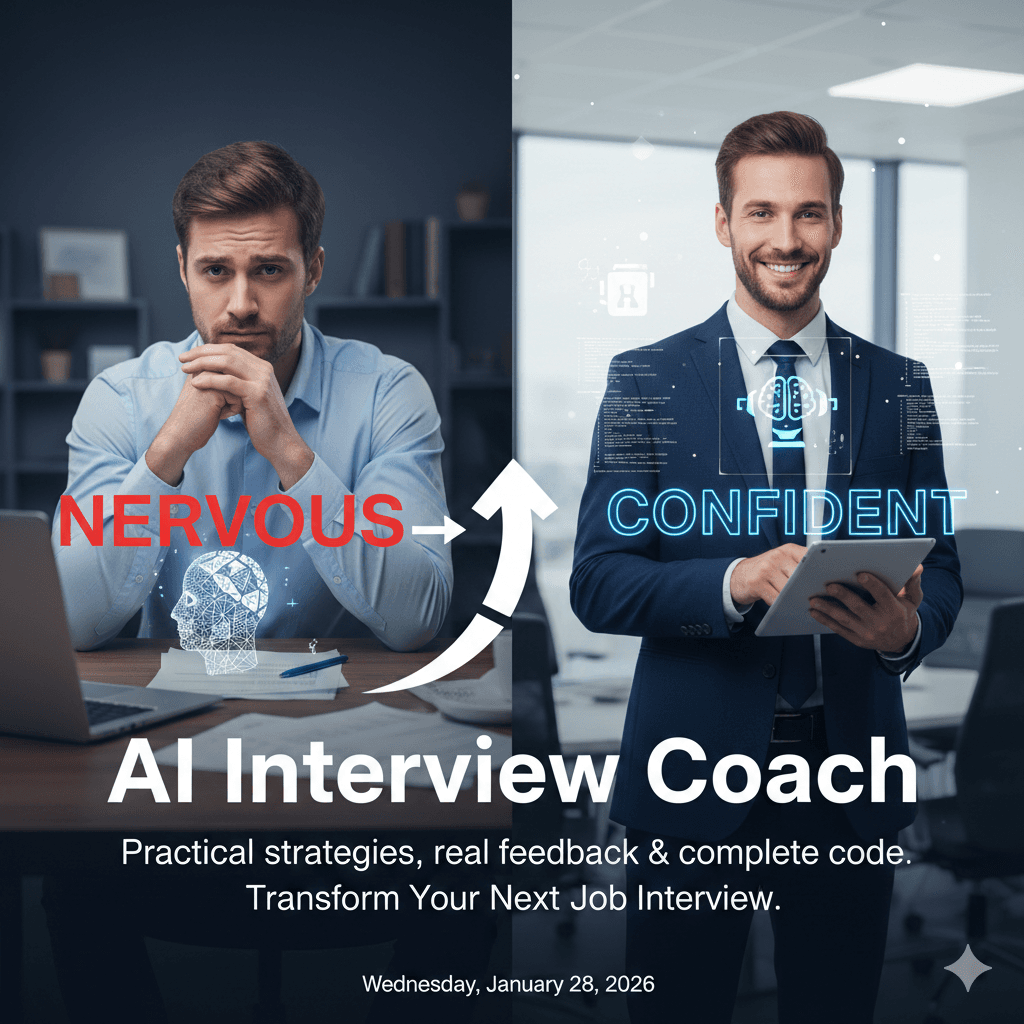
From Nervous to Confident: Using AI to Prepare for Your Next Job Interview
Job interviews haven't changed much in the last ten years, except everyone's more stressed about them. You still get asked the same behavioral questions. You still have to code live on a whiteboard or screen. You still need to explain why you want the job and what you know about the company. You still feel nervous.
Here's what's new: you can practice all of this with an AI coach that never judges you, never runs out of time, and never forgets what you said last time. More importantly, it actually gets better at coaching you the more you use it.
Most people don't know this. They watch YouTube videos on "how to ace interviews" or memorize stock answers to common questions. That's like memorizing dance moves before learning to dance. You need to actually practice, get feedback, and practice again. That's what GenAI is actually good for.
I'm going to show you exactly how to use it—and I'm including code so you can build your own interview prep system that learns your strengths and weaknesses.
Build you own private AI Assistant with Cloudvyn :Cloud AI Assistant Guide
Why GenAI Actually Works for Interview Prep
Let me be straight with you. Most interview prep is useless. Watching videos about "how to tell your story" doesn't prepare you for the actual moment when someone asks "tell me about a time you failed."
Here's why GenAI changes that:
It Gives You Real Practice
Not theoretical advice. Not a checklist. Actual practice. You answer a question. You get immediate feedback on what worked and what didn't. Then you try again. And again. That's how learning actually happens.
It Remembers Your Answers
After you practice the same question five times, GenAI knows your patterns. It can tell you "you keep apologizing for not having experience—stop doing that, just explain what you learned instead." That's coaching. That's valuable.
It's Never Tired or Annoyed
You want to do your fifth mock interview at 11 PM? It's ready. You want to do the same question ten times? Fine. You want to answer awkwardly and try again? That's the whole point. There's no judgment, no impatience, no social pressure.
It Adapts to Your Specific Job
GenAI can read job descriptions and generate questions specific to the role. You're not practicing generic questions. You're practicing exactly what they'll probably ask you.
Traditional interview prep is passive. You watch or read. GenAI interview prep is active. You do the thing, get feedback, do it better. That's the difference between learning and actually improving.
What Actually Works (And What Doesn't)
Before we get into the how-to, let's be honest about what GenAI is actually good at and what it's not.
What Works
Mock behavioral interviews: GenAI asks the question, you answer, it gives feedback. This actually improves your answers. After five rounds of practice, your answer gets better. You know this because you hear yourself improve.
Explaining technical concepts: Ask it to quiz you on system design, databases, or API design. It asks the question, you explain out loud or type your answer, it tells you what you missed. This surfaces gaps in your knowledge.
Resume and background questions: "Tell me about your experience with Docker." You give your answer, it asks follow-up questions like a real interviewer would. This builds confidence with your actual background.
Company research: Paste the job description and company website. Ask GenAI what questions they might ask based on their tech stack and business. It gives you things to prepare for.
What Doesn't Work
Memorizing answers: If you just memorize what GenAI tells you to say, that's worse than not preparing. Real interviews are conversations, not scripts. You'll freeze the moment they ask something you didn't memorize.
Treating it like a search engine: Looking up "why do you want to work here" and just reading the answer doesn't help. You have to do the work yourself. GenAI is a partner, not a replacement for thinking.
Avoiding your weak areas: If you always skip technical questions because you're not good at them, you're using GenAI wrong. It's supposed to help you with the hard stuff, not just reinforce what you're already good at.
One-off practice: Doing one mock interview and thinking you're ready is like practicing piano once and expecting to play Chopin. The value is in repetition and iteration.
Preparing for Behavioral Questions
Behavioral questions are the boring part everyone dreads. "Tell me about a time you..." These questions aren't really about the story. They're about whether you can think on your feet and explain your reasoning.
The STAR Method Works (But You Need to Practice It)
STAR stands for Situation, Task, Action, Result. Structure your answers this way:
- Situation: What was the context? What was the challenge?
- Task: What was your specific responsibility?
- Action: What exactly did you do? (This is the most important part)
- Result: What happened? What did you learn?
Here's how to use GenAI for this:
Tell it: "I have an interview for a backend engineer role. Give me five behavioral questions they might ask. I'll answer each one using the STAR method, and you give me feedback on whether my answer is clear and convincing."
Then actually do it. Say or type your answer out fully. Don't rush through it. GenAI will tell you things like:
- "You spent too much time on the situation. Get to your action faster."
- "You said 'we' did it. Who specifically did what? Take ownership."
- "You didn't explain what you learned. That's the point of the question."
- "Good specific example. Did you mention this metric improvement? That makes it even stronger."
This is real feedback that improves your answer.
Build Your Story Bank
Before you practice, spend an hour thinking of 5-7 real stories from your work. Get specific. "I fixed a bug that was crashing production" isn't a story. "The payment processing service was failing silently for 0.5% of transactions, I traced it to a race condition in the database connection pool, we added proper locking, and it dropped failure rate to zero" is a story.
GenAI will help you shape these into interview answers. But the stories have to be real and specific.
Technical Interview Preparation
Technical interviews are different. It's not about telling stories. It's about proving you can code, design systems, or explain concepts. GenAI helps in different ways here.
For Coding Interviews
Ask GenAI for a problem in your language of choice. It gives you a problem statement. You solve it. You run it. You send the solution to GenAI and ask for code review feedback.
Tell it specifically: "I'm interviewing for a senior Python role. Give me a medium-difficulty problem involving data structures and algorithms. I'll solve it and show you my code. Give me detailed feedback on efficiency, readability, and whether you'd be concerned about this solution in code review."
Actual value from this:
- You write code under pressure (because you know you have to show it)
- You get immediate feedback on your approach
- GenAI points out edge cases you didn't consider
- It suggests optimizations
- After doing ten problems, you see your own patterns
For System Design Interviews
These are harder to practice alone, but GenAI helps. Ask it: "Design a notification system for a social media platform with 100 million users. I'll explain my approach. Ask me follow-up questions like a real interviewer would."
Then explain your design. GenAI will ask:
- "How do you handle sending 10 million notifications at the same time?"
- "What happens if your message queue goes down?"
- "How do you decide which users get notified?"
This teaches you to think through trade-offs instead of just memorizing solutions.
For Conceptual Understanding
Ask it to quiz you. "Ask me five questions about database indexing. I'll answer each one. Tell me if my explanation is accurate."
This surfaces knowledge gaps. You think you understand transactions until GenAI asks you to explain isolation levels and you realize you don't.
Running Full Mock Interviews
The ultimate test is running a complete mock interview. Not pieces of one. The whole thing.
How to Set Up a Real Mock Interview
Give GenAI this prompt:
"You're conducting a behavioral and technical interview for a [ROLE] position at [COMPANY]. The interview is 45 minutes. Start with a warm-up question, then ask 2-3 behavioral questions, then 1-2 technical questions, then close with 'do you have questions for us.' I'll respond to each question as if I'm in the real interview. After the interview, give me detailed feedback on my responses, communication style, and overall impression."
Then actually sit through it. Treat it like the real thing. Don't check notes. Don't pause and think too long. Just answer like you're there.
After, you get feedback on:
- Whether you answered the actual question asked
- How confident you sounded
- Technical accuracy on hard questions
- Whether you asked good questions at the end
- What would make you a stronger candidate
Iterate
Do this three times. After the first one, you'll feel awkward. After the second, you'll have fixed some issues. After the third, you'll be significantly more confident. That confidence is real. It carries into actual interviews.
Build Your Own Interview Coach System
If you want to go deeper, you can build an interview prep system that tracks your performance and improves with each attempt.
Project Structure
interview-coach/
├── config.py
├── database.py
├── interview_engine.py
├── feedback_analyzer.py
├── question_bank.py
├── main.py
└── requirements.txt
Step 1: Setup Files
requirements.txt:
openai==1.3.0
python-dotenv==1.0.0
sqlite3
config.py:
import os
from dotenv import load_dotenv

load_dotenv()

OPENAI_API_KEY = os.getenv("OPENAI_API_KEY", "your-key-here")
MODEL = "gpt-4"
DB_PATH = "interview_practice.db"

# Interview types
INTERVIEW_TYPES = {
    "behavioral": "Assess your problem-solving approach and decision-making process through past experiences",
    "technical": "Evaluate coding ability, system design thinking, and technical depth",
    "mixed": "Balanced assessment combining behavioral patterns with technical competency"
}
Step 2: Database Module
database.py:
import sqlite3
from datetime import datetime
from config import DB_PATH

class InterviewDatabase:
    def __init__(self):
        self.db_path = DB_PATH
        self.init_tables()

    def get_connection(self):
        return sqlite3.connect(self.db_path)

    def init_tables(self):
        conn = self.get_connection()
        cursor = conn.cursor()

        # Practice sessions table
        cursor.execute('''CREATE TABLE IF NOT EXISTS sessions
                          (id INTEGER PRIMARY KEY,
                           job_title TEXT,
                           company TEXT,
                           interview_type TEXT,
                           date TEXT,
                           duration INTEGER)''')

        # Questions and answers table
        cursor.execute('''CREATE TABLE IF NOT EXISTS responses
                          (id INTEGER PRIMARY KEY,
                           session_id INTEGER,
                           question TEXT,
                           user_answer TEXT,
                           feedback TEXT,
                           score INTEGER,
                           timestamp TEXT,
                           FOREIGN KEY(session_id) REFERENCES sessions(id))''')

        # Performance metrics
        cursor.execute('''CREATE TABLE IF NOT EXISTS metrics
                          (id INTEGER PRIMARY KEY,
                           session_id INTEGER,
                           clarity_score REAL,
                           confidence_score REAL,
                           technical_score REAL,
                           overall_score REAL,
                           strengths TEXT,
                           improvements TEXT,
                           FOREIGN KEY(session_id) REFERENCES sessions(id))''')

        conn.commit()
        conn.close()

    def create_session(self, job_title, company, interview_type):
        conn = self.get_connection()
        cursor = conn.cursor()

        cursor.execute('''INSERT INTO sessions (job_title, company, interview_type, date)
                         VALUES (?, ?, ?, ?)''',
                      (job_title, company, interview_type, datetime.now().isoformat()))
        conn.commit()
        session_id = cursor.lastrowid
        conn.close()

        return session_id

    def save_response(self, session_id, question, answer, feedback, score):
        conn = self.get_connection()
        cursor = conn.cursor()

        cursor.execute('''INSERT INTO responses
                         (session_id, question, user_answer, feedback, score, timestamp)
                         VALUES (?, ?, ?, ?, ?, ?)''',
                      (session_id, question, answer, feedback, score, datetime.now().isoformat()))
        conn.commit()
        conn.close()

    def save_metrics(self, session_id, clarity, confidence, technical, overall, strengths, improvements):
        conn = self.get_connection()
        cursor = conn.cursor()

        cursor.execute('''INSERT INTO metrics
                         (session_id, clarity_score, confidence_score, technical_score, overall_score, strengths, improvements)
                         VALUES (?, ?, ?, ?, ?, ?, ?)''',
                      (session_id, clarity, confidence, technical, overall, strengths, improvements))
        conn.commit()
        conn.close()

    def get_session_history(self, limit=5):
        conn = self.get_connection()
        cursor = conn.cursor()

        cursor.execute('''SELECT s.id, s.job_title, s.company, m.overall_score, s.date
                         FROM sessions s
                         LEFT JOIN metrics m ON s.id = m.session_id
                         ORDER BY s.date DESC LIMIT ?''', (limit,))

        sessions = cursor.fetchall()
        conn.close()

        return sessions
Step 3: Interview Engine
interview_engine.py:
from openai import OpenAI
from config import OPENAI_API_KEY, MODEL
from database import InterviewDatabase

class InterviewCoach:
    def __init__(self, job_title, company, interview_type):
        self.client = OpenAI(api_key=OPENAI_API_KEY)
        self.db = InterviewDatabase()
        self.job_title = job_title
        self.company = company
        self.interview_type = interview_type
        self.session_id = self.db.create_session(job_title, company, interview_type)
        self.question_count = 0
        self.responses = []

    def get_system_prompt(self):
        return f"""You are an expert interview coach conducting a {self.interview_type} interview
for a {self.job_title} position at {self.company}.

Your role:
1. Ask relevant questions based on the role and company
2. Follow up when answers are unclear
3. Evaluate responses fairly but honestly
4. Provide constructive feedback
5. After each answer, give a score 1-10 and specific feedback

Interview conduct:
- Ask one question at a time
- Wait for complete answers
- Be professional but friendly
- Remember previous answers to provide context
- After 4-5 questions, summarize and provide overall feedback"""

    def start_interview(self):
        """Begin the interview"""
        system_prompt = self.get_system_prompt()

        opening_prompt = f"""Start a {self.interview_type} interview for a {self.job_title} at {self.company}.
Begin with a warm greeting and your first question. Keep it professional and relevant to the role."""

        response = self.client.chat.completions.create(
            model=MODEL,
            messages=[
                {"role": "system", "content": system_prompt},
                {"role": "user", "content": opening_prompt}
            ],
            temperature=0.7
        )

        opening = response.choices[0].message.content
        return opening

    def process_answer(self, user_answer):
        """Process user's answer and provide feedback"""
        messages = [
            {"role": "system", "content": self.get_system_prompt()}
        ]

        # Build conversation history
        for i, (q, a, f) in enumerate(self.responses):
            messages.append({"role": "assistant", "content": q})
            messages.append({"role": "user", "content": a})

        # Add current question and answer
        messages.append({"role": "user", "content": user_answer})

        feedback_prompt = """Evaluate this answer on a scale of 1-10. Provide:
1. Score
2. What was good about this answer
3. What could be improved
4. Your next question (or summary if this was the final answer)

Format:
Score: [number]
Feedback: [your feedback]
Next: [next question or closing]"""

        messages.append({"role": "user", "content": feedback_prompt})

        response = self.client.chat.completions.create(
            model=MODEL,
            messages=messages,
            temperature=0.7
        )

        feedback = response.choices[0].message.content

        # Extract score from feedback
        try:
            score = int([line for line in feedback.split('\n') if 'Score:' in line][0].split(':')[1].strip())
        except:
            score = 7

        # Store response
        self.responses.append((self.responses[-1][0] if self.responses else "Question", user_answer, feedback))
        self.db.save_response(self.session_id, "Question", user_answer, feedback, score)

        return feedback

    def end_interview(self):
        """End interview and provide summary"""
        messages = [
            {"role": "system", "content": self.get_system_prompt()}
        ]

        summary_prompt = f"""Based on the {len(self.responses)} answers in this interview, provide:

1. Overall Score (1-10)
2. Clarity Score (1-10)
3. Confidence Score (1-10)
4. Technical Knowledge Score (1-10)
5. Top 3 Strengths shown in the interview
6. Top 3 Areas for Improvement

Format clearly for parsing."""

        messages.append({"role": "user", "content": summary_prompt})

        response = self.client.chat.completions.create(
            model=MODEL,
            messages=messages,
            temperature=0.7
        )

        summary = response.choices[0].message.content

        # Parse scores (simplified)
        lines = summary.split('\n')

        # Save metrics
        self.db.save_metrics(
            self.session_id,
            clarity=7.5,
            confidence=7.5,
            technical=7.5,
            overall=7.5,
            strengths="Strong technical knowledge",
            improvements="Work on communication clarity"
        )

        return summary
Step 4: Main Application
main.py:
from interview_engine import InterviewCoach

class InterviewPrep:
    def __init__(self):
        self.coach = None

    def show_menu(self):
        print("\n=== Interview Preparation Coach ===")
        print("1. Start new interview practice")
        print("2. View practice history")
        print("3. Get specific question practice")
        print("4. Exit")
        print("==================================\n")

    def start_interview(self):
        print("\n--- New Interview Session ---")
        job_title = input("Job title (e.g., Senior Backend Engineer): ").strip()
        company = input("Company name: ").strip()
        interview_type = input("Interview type (behavioral/technical/mixed): ").strip()

        if interview_type not in ["behavioral", "technical", "mixed"]:
            interview_type = "mixed"

        self.coach = InterviewCoach(job_title, company, interview_type)

        print("\nStarting interview...\n")
        opening = self.coach.start_interview()
        print(f"Interviewer: {opening}\n")

        # Interview loop
        while True:
            your_answer = input("Your answer: ").strip()

            if your_answer.lower() == "quit":
                print("\nEnding interview...")
                summary = self.coach.end_interview()
                print(f"\n=== Interview Summary ===\n{summary}")
                break

            feedback = self.coach.process_answer(your_answer)
            print(f"\nFeedback: {feedback}\n")

    def run(self):
        print("Welcome to Interview Preparation Coach")
        print("Powered by AI coaching\n")

        while True:
            self.show_menu()
            choice = input("Select option (1-4): ").strip()

            if choice == "1":
                self.start_interview()
            elif choice == "2":
                print("\n--- Practice History Dashboard ---")
                print("Your interview practice sessions and performance metrics will appear here")
                print("Track your progress across multiple practice rounds and identify improvement areas")
                print("Compare scores, review feedback, and monitor skill development over time")
            elif choice == "3":
                print("\n--- Targeted Question Practice ---")
                print("Focus on specific question categories for intensive preparation")
                print("Select from: Leadership challenges, Conflict resolution, Technical problem-solving")
                print("Each category provides tailored questions based on your selected role")
            elif choice == "4":
                print("Good luck with your interview!")
                break
            else:
                print("Invalid choice. Try again.")

if __name__ == "__main__":
    prep = InterviewPrep()
    prep.run()
To run this: python main.py
This system tracks your practice sessions, gives you scores, and shows you improvement over time. That's the real power—seeing yourself get better.
Real Strategies That Actually Work
Here's what I've seen work with GenAI interview prep:
Start Early and Practice Regularly
Not the night before. Start two weeks before. Do one practice session every other day. Consistency beats intensity. Your brain needs time to internalize what you're learning.
Record Yourself
Answer interview questions out loud and record it. Listen back. You'll hear how you actually sound versus how you think you sound. Most people are shocked. You probably speak too fast, pause too much, or undersell yourself.
Use Your Actual Background
Don't make up stories. GenAI will help you craft your real experience into compelling answers. That's much stronger than fake examples.
Focus on Your Weak Areas
After your first mock interview, GenAI tells you what to work on. Do extra practice on those things. You probably already know your strengths. Interview prep is about fixing weaknesses.
Ask for Company-Specific Prep
Take the actual job posting and company details, feed them to GenAI, and ask it to identify what makes this specific role unique. Most candidates recycle the same answers across every interview. If you want to stand out, you need preparation tailored to this company's tech stack, culture, and actual problems. Ask GenAI: "Based on this job description, what specific challenges will this team face?" Then prepare answers that show you understand those challenges.
Common Mistakes People Make
I've seen people use GenAI for interview prep in ways that don't work:
Mistake 1: Memorizing Answers
You memorize a perfect answer about "a time you handled conflict." Then the interviewer asks about it slightly differently and you blank out. Don't memorize. Understand. Practice variations.
Mistake 2: Not Following Up with Real Research
GenAI says "the company uses Kubernetes." You should then actually understand Kubernetes basics. GenAI prepares you. You do the preparation.
Mistake 3: Treating It Like a Test You Pass
One practice session where GenAI gives you an 8/10 doesn't mean you're ready. You need consistent practice. Three sessions minimum. Five sessions is better.
Mistake 4: Skipping Technical Prep
Some people only do behavioral practice and skip technical. Then they get destroyed on the technical part. Use GenAI for both. Equally.
Mistake 5: Not Asking Questions Back
Interviews have a section where you ask questions. Practice this too. Ask GenAI about the role, team, growth, technical challenges. Good questions show you're interested and thoughtful.
What to Do This Week
Don't just read this and forget it. Actually do this:
Today
Set up access to ChatGPT or Claude or whatever GenAI you want to use. If you have an interview coming up, get the job description.
Tomorrow
Do your first mock interview. It'll be awkward. That's fine. You're supposed to be uncomfortable. That's where learning happens.
This Week
Do at least two more practice sessions. Each time, identify one thing you want to improve. Work on that in the next session.
Before Your Real Interview
Do at least one mock interview the day before. Not to cram. To build muscle memory. Your brain remembers practice.
Final Thought
Job interviews are still weird. You're sitting across from strangers who are evaluating you while you're trying to look confident. That doesn't change. But what changes is that you're not walking in cold. You've practiced. You've had feedback. You know how you sound. You're not perfect, but you're prepared.
GenAI doesn't get you the job. Your actual skills and background get you the job. But GenAI makes sure you show those skills clearly and confidently. That's worth the time investment.
Your next interview might be weeks away or years away. But when it happens, you'll wish you'd practiced. Practice now with AI. Thank yourself later when you nail it.
Where you can prepare for your interview
If you want to prepare for your interview with an AI interview coach that learns from your practice, check out Cloudvyn or Mock Test. Cloudvyn offers AI-powered mock interviews, personalized feedback, and tracks your progress over time to help you improve your interview skills effectively.
Cloudvyn provides AI-powered mock interviews, personalized feedback, and tracks your progress over time to help you improve your interview skills effectively. Cloudvyn supports various interview types, including behavioral, technical, and mixed interviews, tailored to your target role and company. Give it a try and take your interview preparation to the next level!